Silk Road Treasures
Vintage Hexagonal Bronze Jewelry Die – Rosettes, Stars & Framed Flower with Green Patina
Vintage Hexagonal Bronze Jewelry Die – Rosettes, Stars & Framed Flower with Green Patina
Couldn't load pickup availability
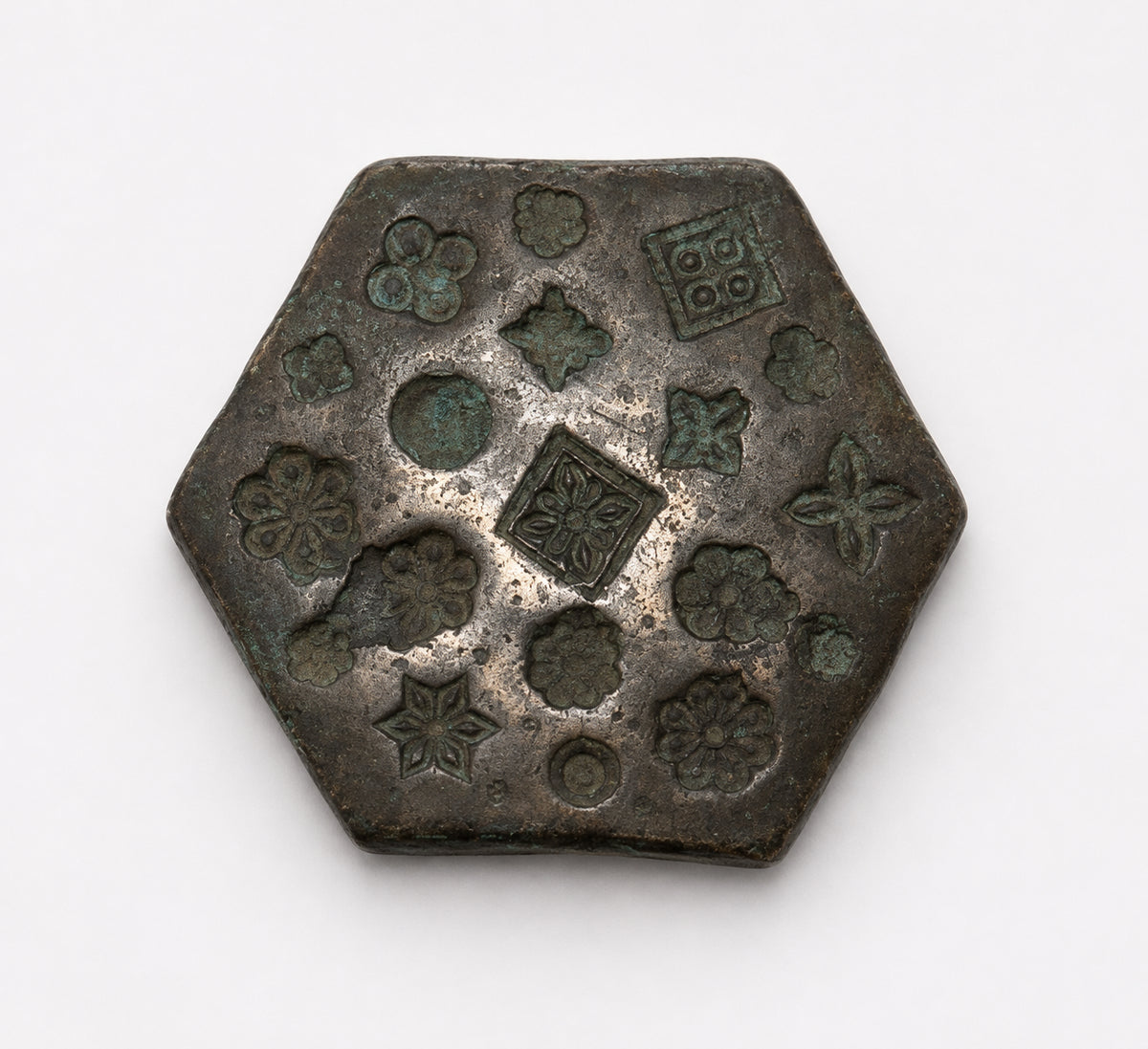
A small, heavy hexagonal bronze die with about twenty hand-cut designs and a soft green patina settled into its recesses.
At its center is an eight-petal flower framed in a square set on its point. Around it are scalloped rosettes in several sizes, a six-point star, a pointed four-petal flower, a cluster of four round domes, a square with four ring-and-dot circles, a plain round dome and a small ring. Rosettes like these are among the oldest ornaments in the world, carved in stone in ancient Mesopotamia and used ever since by jewelers from Persia to India.
A craft more than 2,000 years old. Pressing thin metal into a carved bronze die is one of the oldest ways of making jewelry. In the 1st century BCE, jewelers in the Dacian capital of Sarmizegetusa Regia, in today's Romania, used a hexagonal bronze matrix covered with designs to press sheets of precious metal into ornaments, and bronze was so valuable that they cut designs into every face of it. About 1,500 years ago, goldsmiths in northern Europe made gold pendants called bracteates the same way, laying gold sheet over a bronze matrix and striking it through a layer of lead or wood.
How silversmiths used it. Silversmiths in India and Afghanistan carried the technique into modern times. The smith heats a sheet of silver until it glows red, quenches it in water to soften it, lays it over the die and covers it with a thick sheet of lead. A few heavy hammer blows drive the silver into every recess of the die, and when the lead is lifted away, the design stands out in crisp relief. The pressed shapes are then cut out and soldered into pendants, amulets and other jewelry, often finished with borders pressed from other dies. In India, a jeweler's die like this is called a thappa, a word for a stamp.
Using it today. These dies are collected as working tools of a fading craft and as small works of art in their own right. Metalsmiths can still press annealed silver, copper or brass sheet into them, and artists use them to texture metal clay and polymer clay. On a small stand or in a shadow box, a die makes a striking display piece.
One of a kind: each die was cut by hand and shows years of use at the bench, so no two are alike. You'll receive the exact die pictured.
Details
- Material: bronze
- Shape: hexagon
- Size: approx. 1-11/16 in wide x 1-9/16 in tall (4.3 x 4.0 cm)
- Thickness: approx. 1/4 in (6 mm)
- Measurements are approximate, to within about 1/16 in
- Age: vintage to antique; exact date unknown
- Condition: green patina in the recesses; worn, silvery high points; a worn patch beside one flower at the lower left
- One of a kind: only one available
- Not for use with food
Explore more vintage bronze jewelry dies.